Solar panels, home battery storage and a normal three-pin plug. Put those together and you have the beginnings of something rather exciting: a way to cut electricity bills without committing to an enormous rooftop installation.
That is the promise of plug-in solar, sometimes called balcony solar, and plug-in-ready batteries such as the Jackery SolarVault 3 Pro. Start small, add panels or batteries as you need them, and avoid turning every upgrade into another major installation project.
But hold on a tickety-boo. Plug-in ready does not mean legally approved for plug-in use. That distinction matters enormously in the UK, particularly when a battery is involved.
I am genuinely excited by what this system makes possible. Before getting carried away with the prospect of cheaper electricity, though, we need to separate the hardware, the legislation and the sums.
Quick Summary
- Plug-in-ready battery hardware was not yet authorised to supply UK homes through ordinary sockets at review time.
- The SolarVault 3 Pro expands from 2.52kWh to 15.12kWh with stackable battery modules.
- Cheap-rate charging can make battery storage useful even without solar panels.
- Actual payback depends on installed pricing, tariff differences, energy use and system losses.
Table of Contents
- Why Traditional Solar Leaves So Many People Out
- UK Plug-in Solar Rules: The Important Catch
- What the Jackery SolarVault 3 Pro Actually Includes
- Safety Features That Deserve Attention
- Can a Home Battery Save Money Without Solar?
- What Adding Solar Changes
- Price and Payback: Does the Investment Stack Up?
- My Verdict: The Flexibility Is What Makes This Exciting
Why Traditional Solar Leaves So Many People Out
A conventional solar and battery installation can be a substantial undertaking. Panels need mounting, cables need routing, and a qualified installer needs to connect everything properly. Depending on the system, the bill can exceed £10,000.
Trying to sidestep that with an improvised DIY installation is not the answer. Get electrical work wrong and the consequences can be catastrophic. There can also be problems with insurance, compliance and qualifying to export surplus electricity.
Then there are people who cannot make permanent changes to their property at all. Renters, people in housing with restrictions, and flat owners without access to a suitable roof or garden can find themselves excluded before they have even requested a quote.
The attraction of a smaller, modular system is that it lowers some of those barriers. It does not magically create somewhere sunny to put a panel, or remove the need for permission where applicable, but it offers a much less all-or-nothing approach.
The battery matters just as much as the panels
Solar panels have an obvious job: generate electricity from sunlight and reduce the amount you need to buy. A battery adds two useful capabilities:
- Store surplus solar: Keep energy generated during sunny periods for use later.
- Shift electricity costs: Charge from the grid during cheap tariff periods, then discharge when electricity is expensive.
That second point is particularly important. You do not necessarily need solar panels for a home battery to make financial sense. A sufficiently large difference between peak and off-peak electricity prices can do a surprising amount of the work.
UK Plug-in Solar Rules: The Important Catch
The legal position described here is the position at the time of my review, not confirmation of the rules on the day you read this. Check the latest official guidance before purchasing or connecting equipment.
The distinction I had to make was straightforward, even if the terminology makes it sound rather less so:
- The SolarVault 3 Pro is plug-in ready. Its hardware is designed for that type of connection, but hardware capability is not permission to use it.
- The legislative change discussed concerned plug-in solar. It did not automatically authorise plug-in battery storage.
- The announced start date for compliant plug-in solar was 27 August. The stated household supply limit was up to 800W.
- Battery power fed into a UK home through a three-pin socket was not yet authorised. No approval date had been set for that use at the time of the review.
- To supply the house from the Jackery battery at that point, it needed a hardwired connection installed by a qualified electrician.
Any socket-connected demonstrations were illustrative, not an instruction to connect a battery to your home that way.
For updates, start with the Department for Energy Security and Net Zero and confirm the requirements that apply to the specific equipment and installation.
You still need to deal with your DNO
Your distribution network operator, or DNO, is the organisation responsible for the local electricity network. It is not necessarily the company sending your electricity bill.
The microgeneration notification route discussed for this system was G98. You need to establish the applicable network requirements and make sure the necessary notification is completed. The Energy Networks Association is a useful starting point for finding network information.
Submitting paperwork does not override restrictions on how equipment may be connected. Both the connection method and the network requirements need to be right.
And please do not start poking screwdrivers into your consumer unit. Get the person with the certificate. In this instance, that is not optional enthusiasm-killing bureaucracy. It is electrical safety.
Hardwiring also unlocks more output
There is a practical advantage to a direct connection, too. The output figures discussed were:
- Compliant plug-in solar: Up to 800W supplied to the home under the announced rules.
- SolarVault 3 Pro, hardwired: Up to 1,200W.
- Pro Max version, hardwired: Up to 2,500W.
I would not assume any future plug-in battery approval will allow the full hardwired output. An 800W limit seemed a plausible possibility, but that was speculation, not a confirmed battery rule.
These are power limits, not storage capacities. A battery may hold plenty of energy while still being limited in how quickly it can supply it to the house.
What the Jackery SolarVault 3 Pro Actually Includes
The SolarVault 3 Pro combines the main controller, connections, a front display and 2.52kWh of internal battery storage in one unit.
This is the central part of the system. Solar panels connect to its side-mounted PV inputs, and the app provides input and output information, operating status and controls.
The main specifications discussed are:
- Built-in storage: 2.52kWh.
- Solar input: Up to 4,000W across four MPPT inputs.
- Panel arrangement described: Two recommended 500W panels per PV input.
- Battery expansion: Up to five additional 2.52kWh modules.
- Maximum total storage: 15.12kWh.
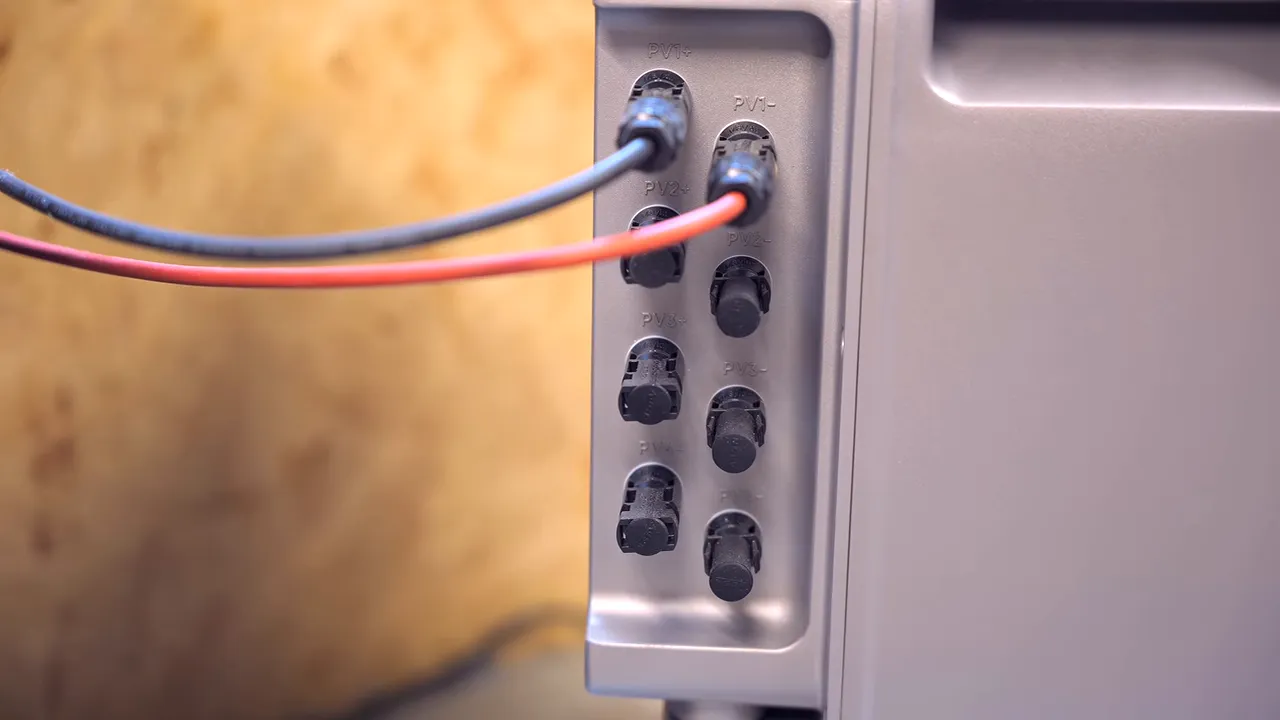
Four solar inputs make expansion much more flexible
The multiple inputs are one of my favourite aspects of the design. Rather than treating the solar array as one fixed installation that must be planned perfectly from the start, you have room to expand.
Perhaps you have space for panels on two balconies. Perhaps a shed roof is already full, but there is a sunny patch of garden available. Separate inputs give you more flexibility over where those groups of panels go.
For testing, we used a simple timber A-frame in the garden. That allowed the panels to sit away from the house and gave us control over their angle and position, rather than accepting whatever shade and orientation the building imposed.
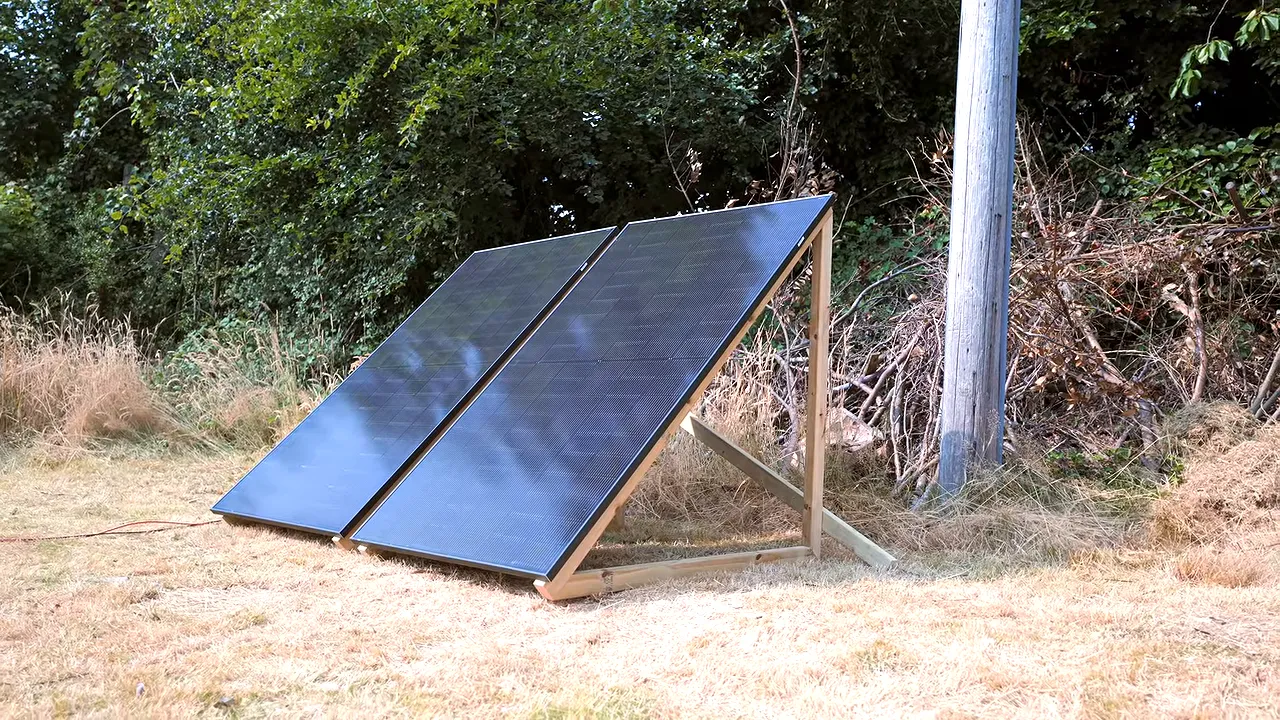
There is much less faffing around when you can use a spare input for an additional compatible panel group. That still means following the product’s electrical limits and connection instructions, not assuming any panel combination will do.
Battery expansion is wonderfully straightforward
Without beating around the bush, 2.52kWh is not a huge amount of home storage. How long it lasts depends on the load, but the base unit is not an unlimited reservoir of electricity.
The answer is to add expansion batteries. Each one contributes another 2.52kWh, with the controller sitting on top of the stack. The physical arrangement is pleasingly Lego-like: expansion module underneath, control unit above.

With five additional modules, total nominal capacity reaches 15.12kWh. More importantly, you do not have to buy the whole lot on day one.
That changes the buying decision. You can start with a smaller system, see how it fits your electricity use, and expand later rather than paying for the largest installation you can possibly accommodate upfront.
Safety Features That Deserve Attention
Home battery safety inevitably comes up whenever these systems are discussed. I cited estimates of around 120,000 installed UK home battery systems and 23 related fire-service call-outs in the preceding year. Those figures were context, not a reason to ignore safe installation or manufacturer guidance.
What gives me more confidence here is the actual safety hardware Jackery has included:
- IP65 rating: Suitable for outdoor positioning within the manufacturer’s requirements, although I would still favour shelter for a permanent outdoor installation.
- Stated operating range: From minus 20°C to 55°C.
- Continuous temperature monitoring: Designed to detect abnormal conditions and send alerts.
- Integrated aerosol fire suppression: An automatic internal module intended to respond at critical temperatures.
That last feature is the standout for me. Think of it as an internal fire-suppression device designed to intervene before an incident develops further.

It is not a feature I would simply expect every premium home battery to include. I highlighted the Tesla Powerwall 3 as a comparison because it does not have an equivalent integrated aerosol module. Jackery deserves praise for including this additional layer of protection.
None of that makes location and installation irrelevant. Safety features complement sensible installation; they do not replace it.
Can a Home Battery Save Money Without Solar?
Yes, potentially. Now things are about to get a little numbery.
My tariff example used the following electricity prices:
- Peak: 31.02p per kWh, from 5:30am until 11:30pm.
- Off-peak: 8p per kWh, from 11:30pm until 5:30am.
The difference is 23.02p per kWh. Charge a battery during the cheaper period and use that stored energy instead of buying peak-rate electricity, and that price gap becomes the basis of your saving.
The roughly 5kWh example
A controller and one expansion battery provide 5.04kWh of nominal capacity, rounded to 5kWh for the simple calculation.
Moving 5kWh a day from the peak rate to the off-peak rate gives approximately:
5 × £0.2302 = £1.15 per day, or about £420 per year.
The rounded annual figure I used was £419.75. That is a meaningful amount of money without generating a single watt from a solar panel.
However, this is an illustrative tariff calculation, not a guaranteed annual saving or a measured year-long result. It assumes you can charge and use that amount every day. A real calculation needs to account for usable capacity, charging and conversion losses, operating behaviour and any tariff changes.
For the largest configuration, I discussed a potential annual saving of roughly £1,237. Again, treat that as a scenario estimate rather than a precise forecast for every 15.12kWh installation.
Smart tariffs could let the battery work harder
My electricity arrangement can also offer cheap charging periods during the day when the supplier schedules my Tesla to charge.
That creates an interesting automation opportunity. The SolarVault 3 Pro supports smart-home connectivity options, so the idea is to trigger battery charging when the car begins a qualifying cheap-rate charging session.
In principle, that means the battery could refill during the day rather than being limited to one overnight charge. The same physical storage could then shift more energy over a full day.
It is a promising use case, but it depends on the tariff, its terms and whether the required automation is supported. The important point is that the electricity plan and the battery need to be considered together. Buying a battery without looking at your tariff misses a large part of the opportunity.
What Adding Solar Changes
Once panels are connected, the system can use their generation to help supply household demand and store surplus energy for later.
That is particularly useful because the maximum solar input is higher than the Pro’s household output limit. When generation exceeds what can be supplied to the house at that moment, available battery capacity gives the excess somewhere useful to go.
I cannot give one honest, universal annual solar-saving figure. It depends heavily on:
- Your location and weather.
- The direction and angle of the panels.
- Shading.
- How much panel capacity you install.
- When your household uses electricity and whether storage is available.
The flexibility is the attraction. You can begin with tariff-based battery savings, then add solar when space and budget allow.
What if you already have solar?
This type of system can also be useful as a separate addition to an existing solar installation, rather than necessarily requiring the original system to be rebuilt.
That does not mean every combination is automatically suitable. The applicable installation and network requirements still matter, and the restriction on feeding battery power through a three-pin socket remains part of the legal position described earlier.
There is also a standalone use case. The SolarVault can be used as an independent solar and battery system without supplying the house wiring. That makes it more versatile than a product intended solely as a permanent household installation.
Price and Payback: Does the Investment Stack Up?
Traditional fixed systems often encourage a large initial purchase. If installation visits are expensive, it makes sense to fit as much as you reasonably need in one go. The downside is a sizeable upfront bill or substantial monthly payments.
I discussed payback periods of around seven to ten years for full fixed solar and battery systems as a broad comparison. That is not a universal rule. The actual result depends on the installation price, generation, consumption and tariff.
The Jackery’s strongest financial argument is its modularity: a smaller starting purchase and the option to expand later.
The pricing available at the time of review
The system was not yet officially on sale in the UK when I reviewed it, so confirmed UK pricing was unavailable. The figures discussed came from Jackery’s German pricing:
- SolarVault 3 Pro controller: Approximately €999 RRP.
- Expansion battery: Approximately €700 RRP.
I also allowed roughly £100 for an electrician to hardwire the system in the example. That was an allowance, not a fixed-price installation promise. Your property and the work required will determine the quote.
Using the pricing assumptions and the roughly £420 annual tariff-saving example, I suggested a payback period of around three and a half years for the controller and one expansion battery.
That was an indicative estimate, not a confirmed UK payback calculation. With hardware prices quoted in euros and savings in pounds, the final UK purchase price and installation quote need to be established before treating any payback period as dependable.
The useful calculation is simple:
Total installed cost ÷ realistic annual net saving = estimated payback period.
A discount reduces the initial cost. Additional useful solar generation or extra cheap-rate charging opportunities could improve savings further. I was enthusiastic about the possibility of substantially shortening payback through clever use, but that should be modelled for your household rather than assumed.
There are multiple configurations and bundles, so it is worth checking the current range and pricing. The product link below may earn me a commission on qualifying purchases.
What about spreading the cost?
Even a cheaper battery system is still a fair chunk of money. One possibility I raised was using a sufficiently long 0% credit offer to spread the purchase, potentially putting electricity-bill savings towards repayments.
I am not a financial adviser, and that is not a recommendation to borrow. Savings vary, repayments remain due, and interest can change the economics completely if the balance is not cleared within the promotional period.
The system needs to make sense for your finances, not just look appealing in an optimistic spreadsheet.
My Verdict: The Flexibility Is What Makes This Exciting
I am thoroughly impressed with the SolarVault 3 Pro. The design is tidy, the battery expansion is wonderfully straightforward, and the combination of multiple solar inputs, tariff-based charging and smart-home possibilities gives it genuine flexibility.
Perhaps there is a little honeymoon-period enthusiasm here. This is an early introduction to a category that could become very competitive, and I expect my wish list to grow as I spend more time with systems like it.
But the underlying appeal is difficult to dismiss. You do not have to buy a roof full of panels and a huge battery in one go. You can buy a smaller amount of storage, make use of a suitable tariff, add panels where practical and expand as your needs change.
The catch is still the “plug-in” part. At the time of review, this battery needed professional hardwiring to supply a UK home. The technology was ready for a simpler connection method before the legislation was.
Even with that limitation, Jackery has put together something genuinely promising. Not an automatic replacement for every fixed solar installation, and certainly not guaranteed money in your pocket, but a much more approachable route into home energy storage. That is worth getting excited about.


