Just when I thought portable electric heaters had run out of interesting things to do, Dreo produced something that looks suspiciously like it belongs in the heart of the TARDIS.
The Dreo Whole-Room Heater 720S has a top that lifts out of the body. It is wonderfully theatrical, but more importantly, it serves a useful purpose: switching between a focused stream of warm air and gentler, 360-degree heat distribution.
Alongside it is the Convector Heater 711S, a slim, smart-controlled alternative that can stand on its own feet or mount to a wall. It is arguably one of the nicest-looking convector heaters I have come across, although the 720S is unquestionably the more interesting bit of kit.
The important question is whether all this cleverness makes winter more comfortable, rather than simply making the heater more entertaining.
Quick Summary
- The 720S switches between focused airflow and gentler 360-degree heat distribution using its lifting top.
- App controls add target temperatures, schedules, open-window detection and customisable ambient lighting.
- The fanless 711S offers quiet convection heating with smart controls and optional wall mounting.
- At the quoted prices, the £119 720S costs less than the £139 711S.
How the Dreo 720S Changes Its Airflow
First, a confession: the top does not continuously rise and fall like some sort of electrically powered beating heart. It moves on command to change where the air goes.
Inside the 720S are two horizontally arranged, impeller-style fans. These draw air through the lower rear section, push it upwards through the centre of the device and across the ceramic heating elements, then send it out into the room.
With the top lowered, that warmed air exits through the directional metal grille at the front. The result is a concentrated stream of heat, useful when you want warmth aimed at you rather than spread around everyone else.
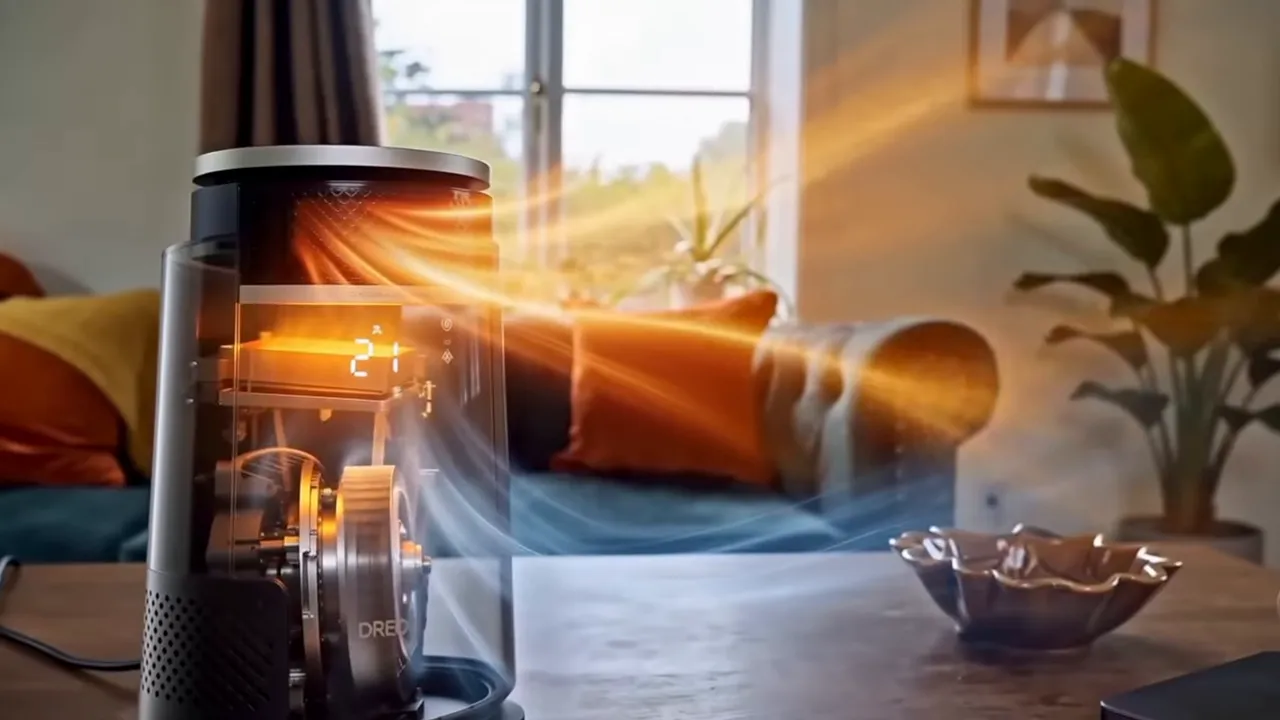
Dreo quotes an airspeed of 12.8 feet per second, which is higher than the Whole-Room Heater 714 I tested previously. Our own measurement just beyond the outlet was approximately 9.4 feet per second. That is below the headline figure, but still a substantial directional airflow for a heater of this shape and size.
The limitation is precisely that word: directional.
Lift the top for 360-degree heating
The older 714 tackles heat distribution by oscillating. The 720S takes a different approach.
When its top rises, the airflow is redirected away from the front grille and out through the opening at the top. It follows the curved surfaces and spreads around the heater in a 360-degree pattern.
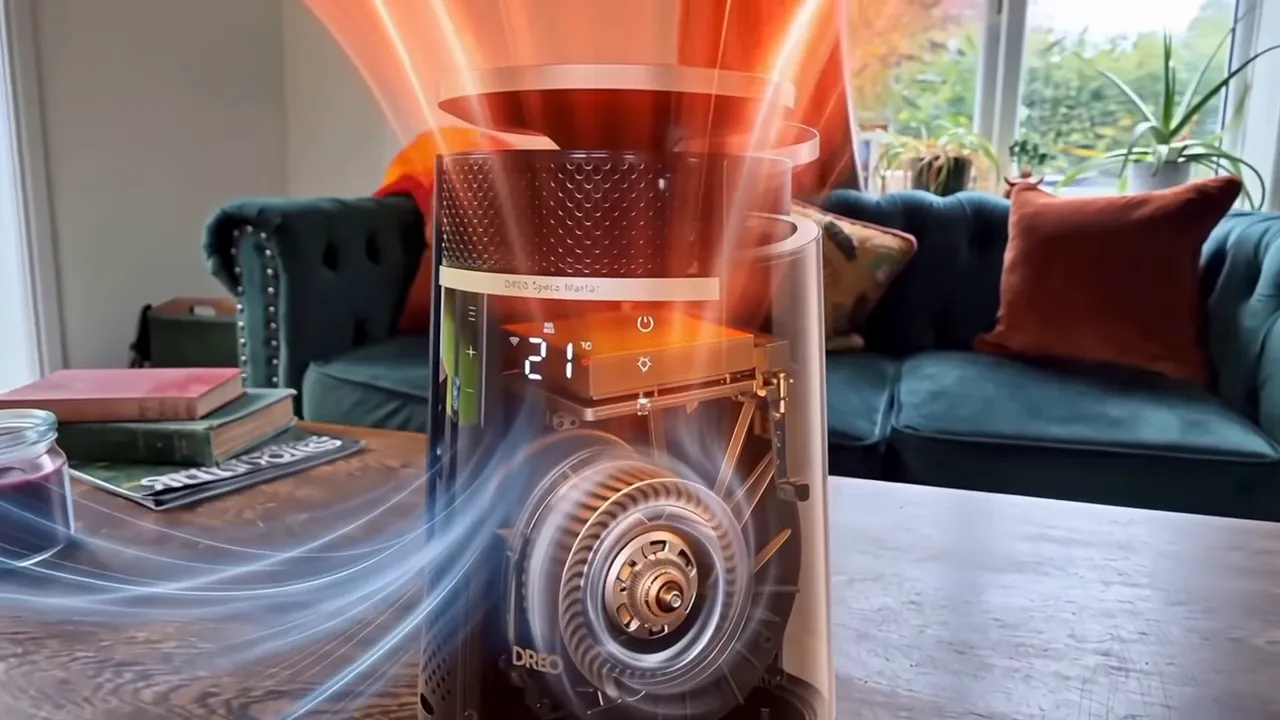
That gives you two genuinely different ways to use the same appliance:
- Directional airflow: a focused stream when you want heat aimed towards one position.
- 360-degree airflow: lower-velocity distribution when you want a more comfortable shared space.
It is not merely a moving lid for the sake of having a moving lid. Although, admittedly, I would probably still find that rather entertaining.
Why It Feels More Comfortable Than Oscillation
A directional heater is perfectly good until the person sitting in front of it starts roasting while somebody else is still wearing a parka indoors.
Oscillation helps, but it does not entirely solve that problem. Instead of receiving a constant jet of hot air, you receive a jet of hot air every time the heater sweeps past you.
In my experience, the 720S with its top raised produces a much nicer ambient warmth. Air moves more gently, and the heat feels more evenly distributed rather than repeatedly blasting one part of the room.
That is particularly appealing when several people are sharing a space, or when you have warmed up and no longer want a concentrated stream pointed at your knees. You can settle down with a packet of jelly babies without needing either an indoor scarf or periodic oven treatment.
Better distribution is not extra heating efficiency
There is an important distinction here. The 714 and 720S use the same underlying ceramic heating system. The 720S is not creating more heat from the same electricity simply because its top moves.
Put 1,500 watts of electric heating into the same room under comparable conditions and the overall heat input is similar. Placement and airflow change where that warmth ends up and how quickly you feel comfortable.
For supporting context, the US Department of Energy explains the basic principle of electric resistance heating: the incoming electrical energy is converted into heat at the point of use. The meaningful advantage here is how the heat is delivered and controlled, not a miraculous new relationship with physics.
Could the design also help longevity?
There is a possible durability benefit, too. An oscillating heater repeatedly moves its body to distribute air. The 720S can distribute heat around itself while remaining stationary, with the top moving only when you change its position.
That could mean less ongoing mechanical movement during use. However, it is a theoretical advantage, not a long-term reliability result. A lifting mechanism is still a mechanism, and I cannot tell you from this test how it will behave after years of winters.
Smart Controls That Are More Useful Than the Remote
The 720S comes with a remote, which in my house means it will almost immediately become a permanent resident of the bottom drawer.
The reason is that the app gives you control over pretty much everything I would want to adjust:
- Heating modes and an exact target temperature.
- Schedules for heating at the times you need it.
- Open-window detection, designed to stop heating when an open window is detected.
- Ambient RGB lighting, including static colours and effects.
- A lighting option that indicates the current room temperature.
The light is a pleasant finishing touch rather than the reason to buy a heater. Being able to use it as a temperature indicator gives it a practical purpose beyond making the thing look even more like alien machinery.
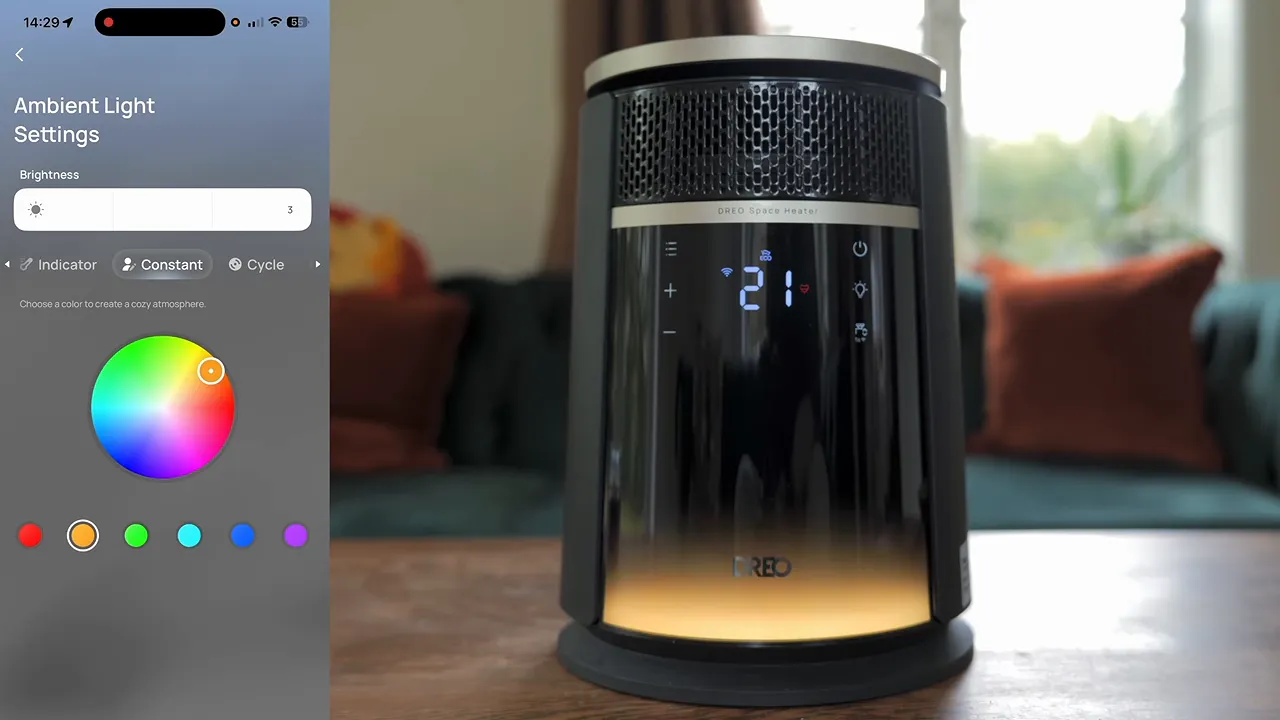
Once connected to Wi-Fi, there are also smart-home control options through Alexa, Google Home and Home Assistant. That makes it a more useful part of a connected home than an appliance that can only be operated from its own buttons.
Dreo's wider smart-home plans
At IFA, Dreo demonstrated a broader control concept built around a 3D representation of a home. Different Dreo devices appeared in their respective rooms, alongside information such as which appliances were running and overall power usage.
That was a preview, not an available feature I would include in the purchase decision today. Still, it was an encouraging glimpse of a more unified system, especially given how useful the existing individual device controls already are.
Design, Hidden Buttons and Fingerprints
Beyond the lifting top, the 720S has the sort of finish I have come to appreciate from Dreo. One particularly nice detail is the front control panel.
When the heater is off, there is very little indication that most of the buttons exist. Switch it on and the controls illuminate through the glossy frontage.
It looks lovely. Unfortunately, that same gloss also provides an excellent exhibition space for grubby fingerprints.
This is hardly a catastrophic flaw, particularly when the app and remote let you avoid touching it. Nevertheless, a matte finish with controls illuminating through it would be a welcome improvement on a future version.
Safety Features, Including Anti-Pinch Protection
A clever heater still needs to get the unglamorous essentials right. The 720S includes:
- Tip-over shutoff to stop operation if it falls over.
- Overheat protection.
- Thermal insulation.
- A child lock to prevent curious little fingers from changing the controls.
- Anti-pinch protection for the lowering top.
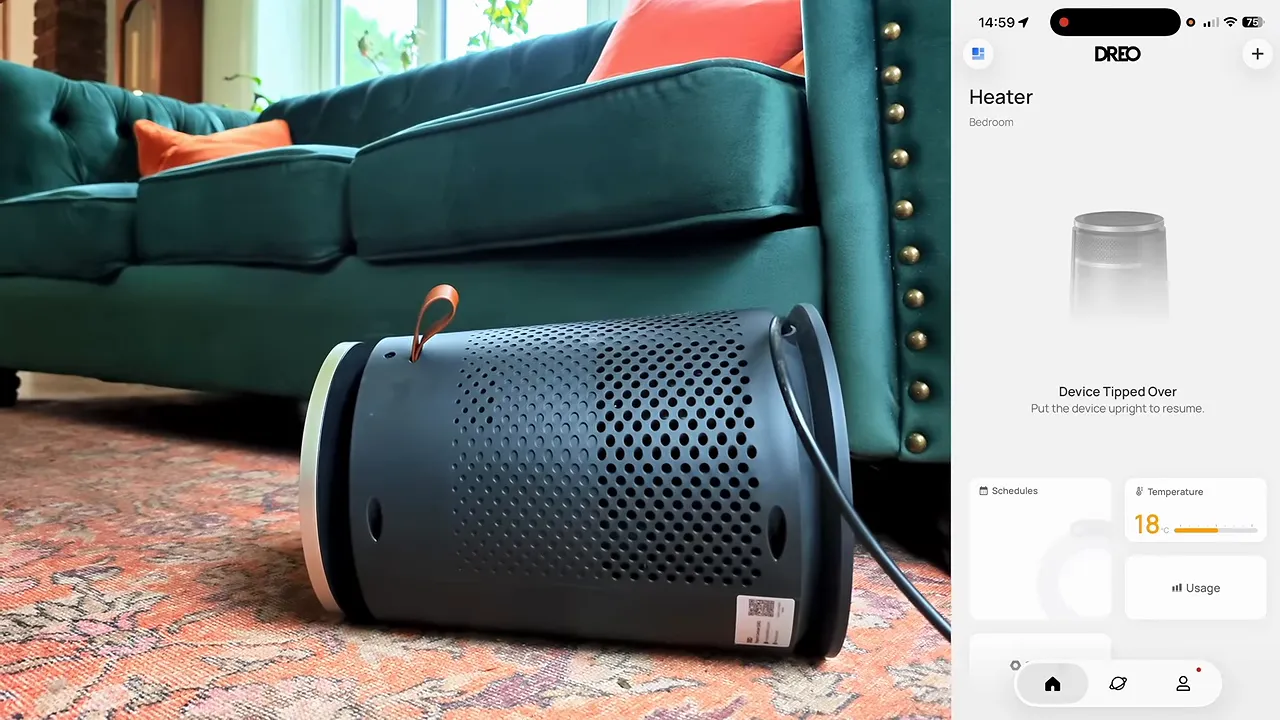
The lifting top introduces a potential pinch point, so that last feature matters. I tested what happened when an obstruction was placed in the gap as the top lowered. The mechanism detected it and reopened rather than continuing to close.
That is reassuring evidence of the feature working in the test, not a reason to deliberately put fingers into moving parts. Similarly, a child lock stops button presses; it is not a substitute for sensible placement and supervision.
Placement, Missing Filtration and Year-Round Use
The 720S creates an interesting placement question. Most of us instinctively put a heater off to one side, near a wall. A device distributing warmth in every direction makes more sense somewhere more central, provided its placement complies with the manufacturer's instructions.
I briefly wondered whether Dreo should have made it taller and added a little tabletop to encourage that central position.
Then I considered the prospect of pouring a drink down an electric heater. This is why I am not an engineer.
The top is not a usable surface, and there is a very sensible argument for keeping it that way.
The other feature I would have liked is built-in air filtration. There is no air purification here, although I appreciate the trade-off: adding filtration restricts airflow and could compromise the rapid heat distribution that makes this design appealing.
What it does offer is fan-only operation with the heating switched off. You can use it as a directional fan outside the heating season, giving it a purpose beyond sitting in a cupboard until winter returns.
Dreo 711S: The Quiet Convector Alternative
The Convector Heater 711S takes a more conventional approach. And Dreo, please, a small plea: these numbers are becoming rather difficult to keep straight.
Unlike the fan-driven 720S, the 711S uses natural convection. Warm air rises, drawing cooler air through the heating elements and continuing the cycle without a fan.
The result is very quiet operation, one of the main reasons to choose this style of electric heater.
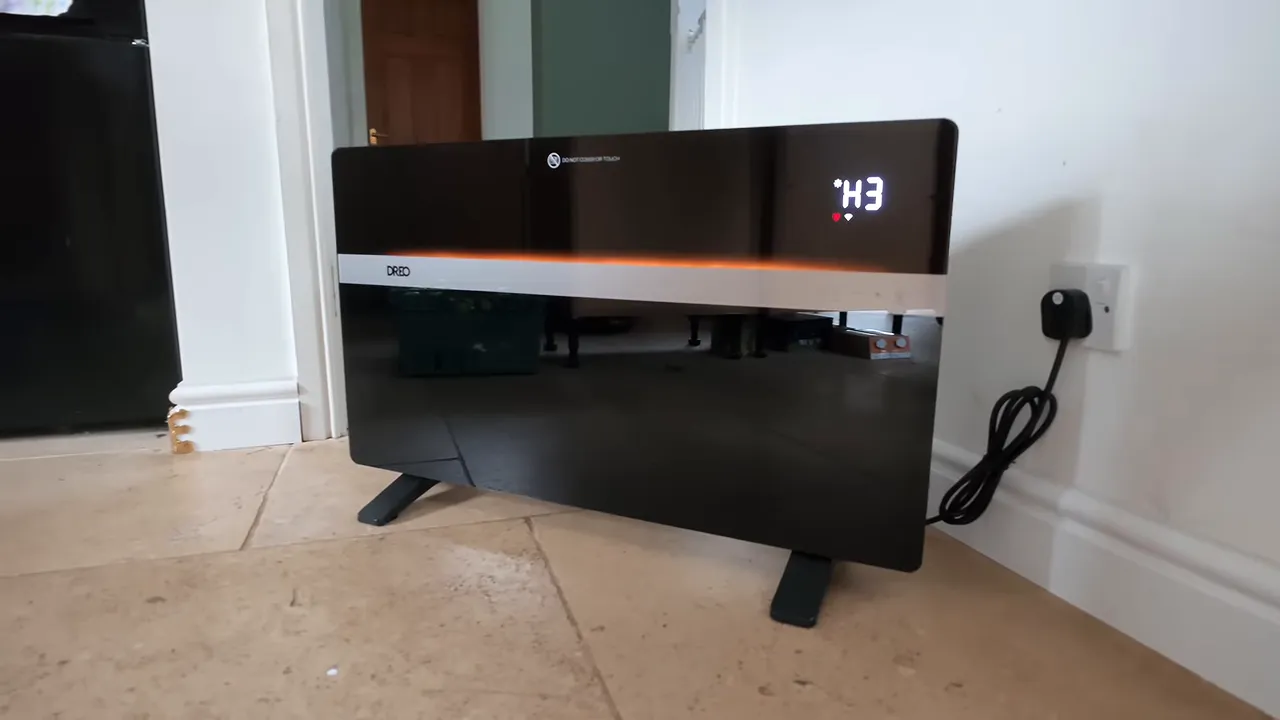
Its other obvious attraction is the design. The slim body looks excellent on the included stands, and wall mounting is an option for a more permanent installation.
For me, though, the real draw is native smart control. Previously, I have used convector heaters with smart plugs, which provide a rather limited form of intelligence: power on, power off.
The 711S offers schedules, target-temperature settings, heating modes and a child lock through its own control system. That is a much more useful arrangement than simply switching the electricity supply.
Prices and Value: 720S vs 711S
The UK prices quoted for these releases were:
- Dreo Whole-Room Heater 720S: £119.
- Dreo Convector Heater 711S: £139.
Those are the prices at the time of the review, rather than a guarantee of current pricing.
The 711S is expensive compared with a basic convector heater that might cost around £30. Part of that premium buys a much more attractive appliance, but the more meaningful difference is the integrated temperature control and scheduling.
Being able to choose a temperature is considerably nicer than interpreting an anonymous numbered dial and hoping level five means “pleasant sitting room” rather than “tropical reptile enclosure”.
That does not mean every inexpensive convector lacks a thermostat. The advantage is clearer temperature selection and more convenient control over when heating runs. Any savings depend on how you use those controls, not on the premium heater somehow producing cheaper watts of heat.
The 720S is the surprise here. At £119, it is less expensive than the convector while offering an unusual airflow system, extensive smart controls and fan-only use. For something this versatile and technologically interesting, I think that is very reasonable.
Current product details are available through the Dreo heater range, with a separate 720S Amazon listing. Product links may be affiliate links and may earn a commission on qualifying purchases.
Should You Buy One?
The Dreo 720S is my pick if you want a portable smart heater with flexible airflow. The moving top is the attention-grabber, but the reason I like it is the choice between direct warmth and a gentler shared-room atmosphere.
The 711S makes more sense if your priorities are fanless operation, a slim profile and the option of mounting the heater on a wall.
My broader advice is to think about portable heating before the first cold snap. During the summer, I saw an Amazon listing for a Dreo misting fan that had been around £150 rise above £2,000. That was an extreme listing price, but it illustrates why I dislike leaving seasonal purchases until demand has already gone mad.
Winter brings similar frustrations with stock and availability. Despite the 720S looking like TARDIS equipment, it cannot take you back to buy a heater before the weather turns.
Even with central heating, a portable unit can provide a quick boost while the house warms up, or act as a backup if the boiler decides to retire at the least convenient moment. Which, naturally, always seems to be winter.
I have very little to complain about with the 720S beyond the fingerprint-friendly finish and a wish for future filtration. If you need a portable heater and enjoy genuinely useful smart technology, this is a particularly compelling one. The theatrical top earns its place.


