Put the Lymow One Plus beside the original Lymow One and you could be forgiven for wondering whether anything has actually changed. It has the same rugged body, enormous front cutting deck and caterpillar tracks. It is rather like being given the shirt you are already wearing.
But after several weeks of testing, I can assure you that the little “Plus” on the end of the name is doing quite a lot of work.
The original Lymow One was one of my favourite robot lawn mower releases of 2025. The Plus keeps what made it so good, particularly on difficult terrain, while making meaningful improvements to cutting power, clearance, obstacle detection and charging. Some are subtle. One, in particular, could save a fair amount of trudging around the garden in wellies.
For a new buyer with the right garden, this is a superb refinement. For an existing Lymow One owner, it is not an automatic reason to upgrade.
Quick Summary
- The One Plus retains the original’s excellent tracked performance on slopes and rough garden terrain.
- Higher clearance, stronger cutting power and improved obstacle detection refine an already capable mower.
- Top-mounted charging pads and dock brushes address the original’s dirty-contact charging problem.
- Existing One owners probably do not need to upgrade, despite the Plus’s meaningful improvements.
Table of Contents
- The Tracks Still Make This a Different Sort of Robot Mower
- Rough Ground, Separate Lawns and More Clearance
- Better Vision and Impressively Quick Obstacle Detection
- The Cutting Deck Gets a Meaningful Power Upgrade
- The Best Change Might Be the Charging Contacts
- The RTK Station Is Still My Main Grumble
- Should Lymow One Owners Upgrade?
- Verdict: Familiar, but Properly Refined
The Tracks Still Make This a Different Sort of Robot Mower
The Lymow One Plus retains that almost industrial design, with a wide mowing deck mounted ahead of a tracked chassis. Caterpillar tracks remain a surprisingly rare inclusion on consumer robot lawn mowers, considering how useful they can be on the right property.
My garden is not a neat, flat rectangle. It has different levels, dips, divots, undulations and the lingering consequences of previous owners neglecting it. This is precisely where the Lymow design makes sense.
We sent the Plus down the steepest slope on the property, which leads towards a brook and reaches roughly 35 degrees at its steepest point. Just like the original One, it absolutely demolished it.
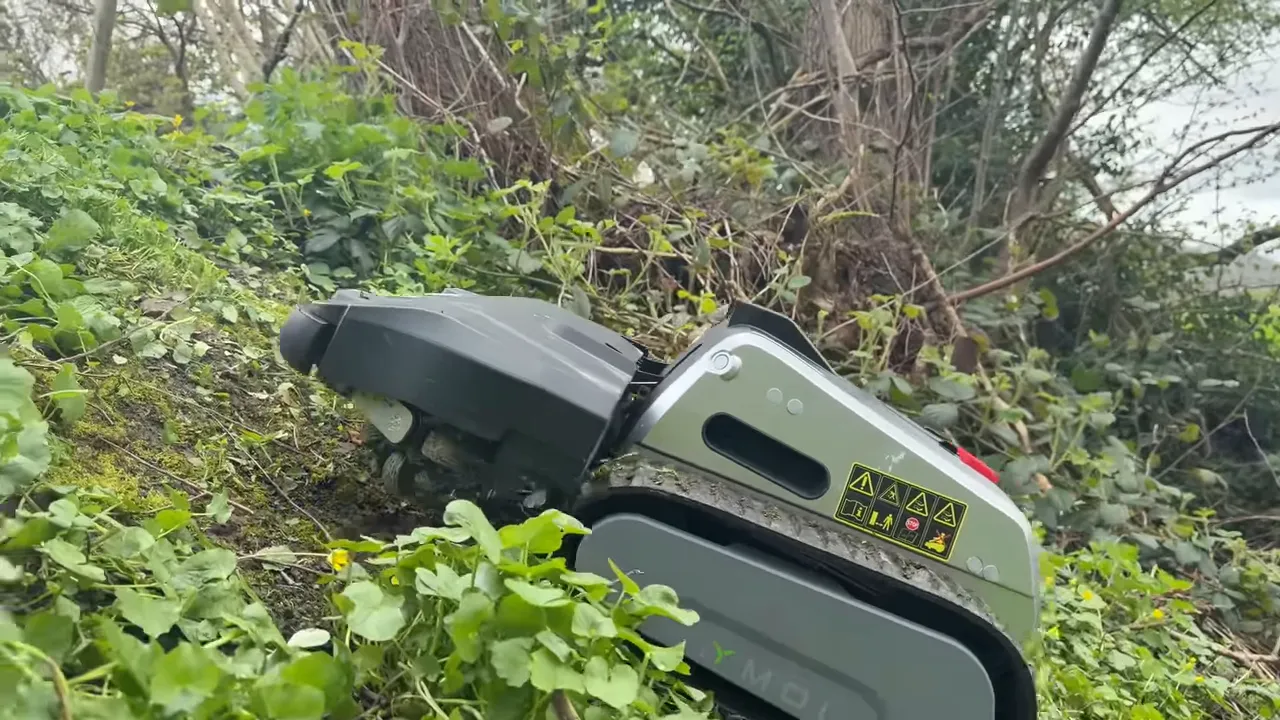
There is also a particularly useful feature here: I can drive it using the controls on my phone while it mows. Remote control itself is not the remarkable bit. Being able to steer and cut at the same time is something I have rarely encountered on robot mowers intended for regular consumer use.
That lets me work it up and down this awkward section rather than relying entirely on an automated mowing session.
For a small, straightforward lawn behind a new-build house, all this might be a bit much. For a complicated countryside garden, it is brilliant.
Cleaner Track Mechanisms
The drive system is functionally much the same as before, but the Plus adds shielding on the inside and self-cleaning mechanisms designed to scrape and brush ingrained dirt and debris out of the moving parts.
I did not personally encounter a problem with debris in the original One’s track mechanisms, so I cannot pretend this fixes something that plagued my testing. It is nevertheless a sensible preventative improvement.
Rough Ground, Separate Lawns and More Clearance
One of the most useful things about the Lymow is not simply what it can mow. It is where it can travel to get there.
We have a separate section of lawn that was an overgrown mess of brambles when we bought the property last year. I have been using the Lymow to keep on top of that area and discourage the brambles from returning.
Getting there involves crossing rough gravel that was torn up for solar-panel cable runs and has not yet been refinished. The tracks allow the mower to cross that rather unpleasant surface and reach the grass beyond.
They also give me much more freedom over where the charging station goes. Mine can live up by the garage, away from the lawns, with the mower following channels I have drawn in the app to reach four individual mowing zones.
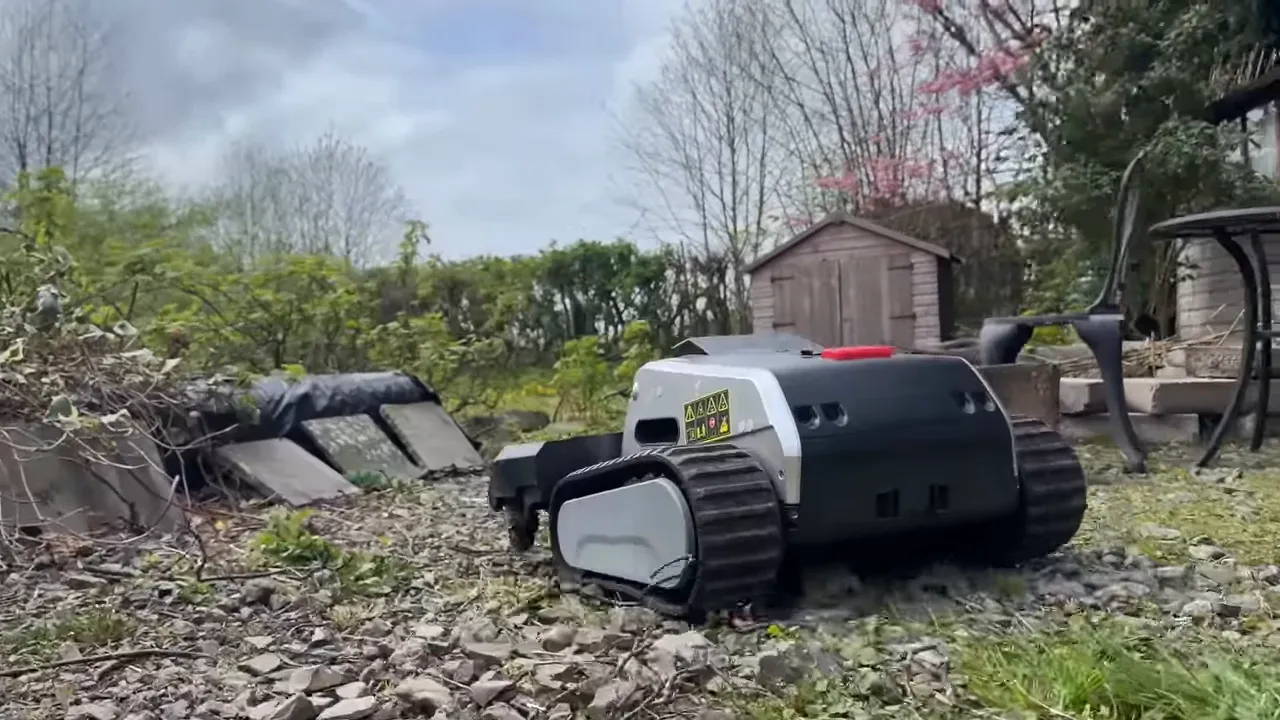
The One Plus makes this a little easier by increasing the robot’s ground clearance:
- Lymow One: 2 inches.
- Lymow One Plus: 2.8 inches, an increase of 40%.
That extra clearance reduces the likelihood of grounding on roots, rocks and other awkward lumps. The original was generally quite good at freeing itself when it did get grounded, helped considerably by those massive tracks. With the Plus, though, I have noticed it grounding less often in the first place.
This is separate from the cutting height. You can still raise the cutting deck to a maximum mowing height of around 4 inches, and the app lets you set different heights for different sections of the garden. The deck also raises automatically when travelling through channels between zones.
It is not the sort of improvement that leaps out at you from across the lawn. Operationally, however, it makes a difference.
Better Vision and Impressively Quick Obstacle Detection
Navigation has received a substantial hardware update. The camera system now has a heated lens, intended to help in fog and rain, alongside an updated vision system and more onboard processing.
The aim is better object recognition and understanding, rather than simply deciding whether something is grass or not grass.
That processing improvement is difficult to isolate and measure during ordinary use, but the reaction speed is not. Obstacle detection has been almost immediate in my testing.
During a run along one of the mapped channels, I stepped into its path. It detected me and stopped dead. Once I moved away, it promptly carried on. An impressive response, although deliberately putting your feet in front of a mower is not a test I would encourage anyone to repeat.
The Ball, the Bin and the Employee of the Month
We also placed several obstacles on the lawn: a ball, a bin and a rather underdressed mannequin standing in as employee of the month.
The mower occasionally got close enough to threaten the mannequin with a shave, but it successfully avoided all the objects. More usefully, the mowing map showed the areas it had left untouched, lining up with the obstacles on the lawn.
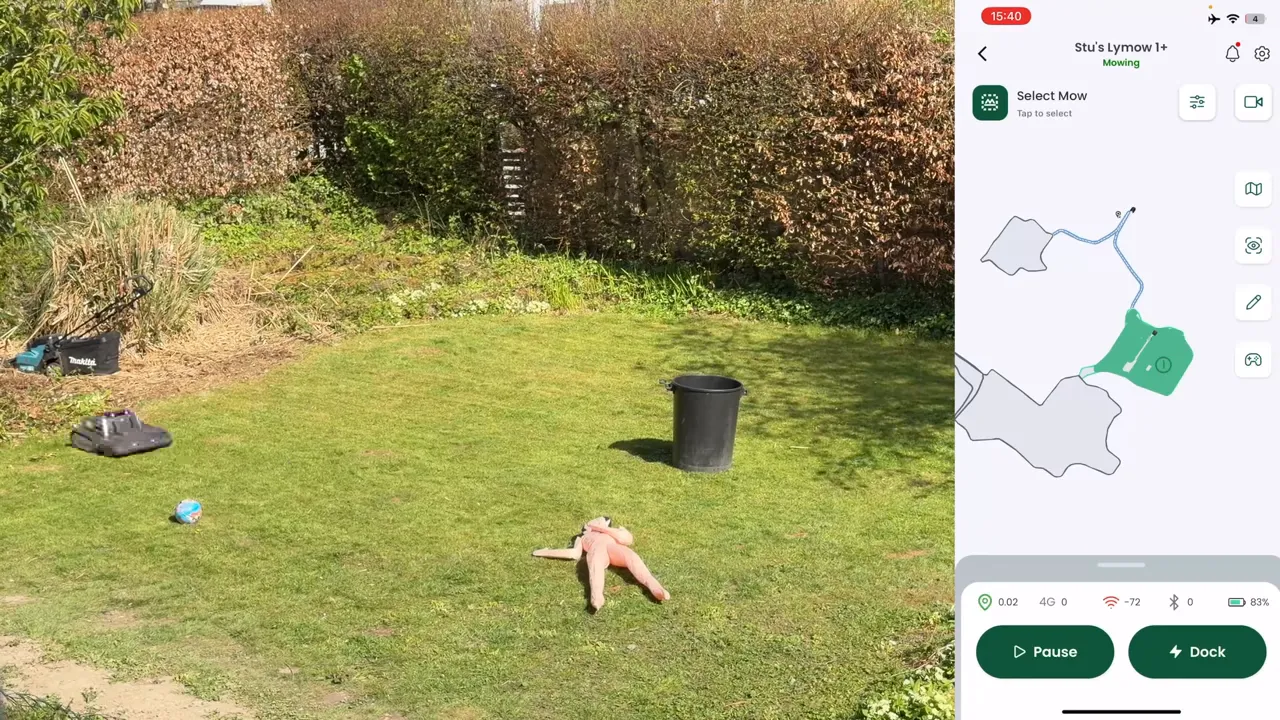
I welcome that extra processing and more refined obstacle handling, especially on a mower with two substantial rotating blades underneath. These are much closer in spirit to conventional lawn mower blades than the little razor-style cutters used by many robot mowers.
Successful obstacle tests are reassuring, but they are not a guarantee that every object, animal or person will always be detected. There is still a serious cutting machine under that friendly robot exterior.
As for the heated lens, my advice remains the same: mow when the grass is dry. That goes for ordinary lawn mowers as well. A lens heater is useful to have, not a reason to send the thing out into a downpour.
The Cutting Deck Gets a Meaningful Power Upgrade
The Lymow One’s cutting system was already a major reason I liked it. Rather than relying on small pivoting razor-style blades, it uses two large rotating blades beneath the front deck.
There is nothing inherently wrong with the smaller-blade approach. It simply tends to struggle more with long or thick growth, and it would not be my choice for the rough section where I am trying to keep bramble regrowth under control.
The Plus retains the larger-blade system but improves several parts of it:
- Revised blade shape to help lift grass while mulching.
- High-carbon steel blades designed for greater durability and longer-lasting sharpness.
- Cutting power increased from 1,200 W to 1,785 W.
- The same 6,000 rpm blade speed as the original.
The important distinction is that the blades are not simply spinning faster. The extra power helps them maintain their speed more consistently under heavier loads, such as thicker or longer grass.
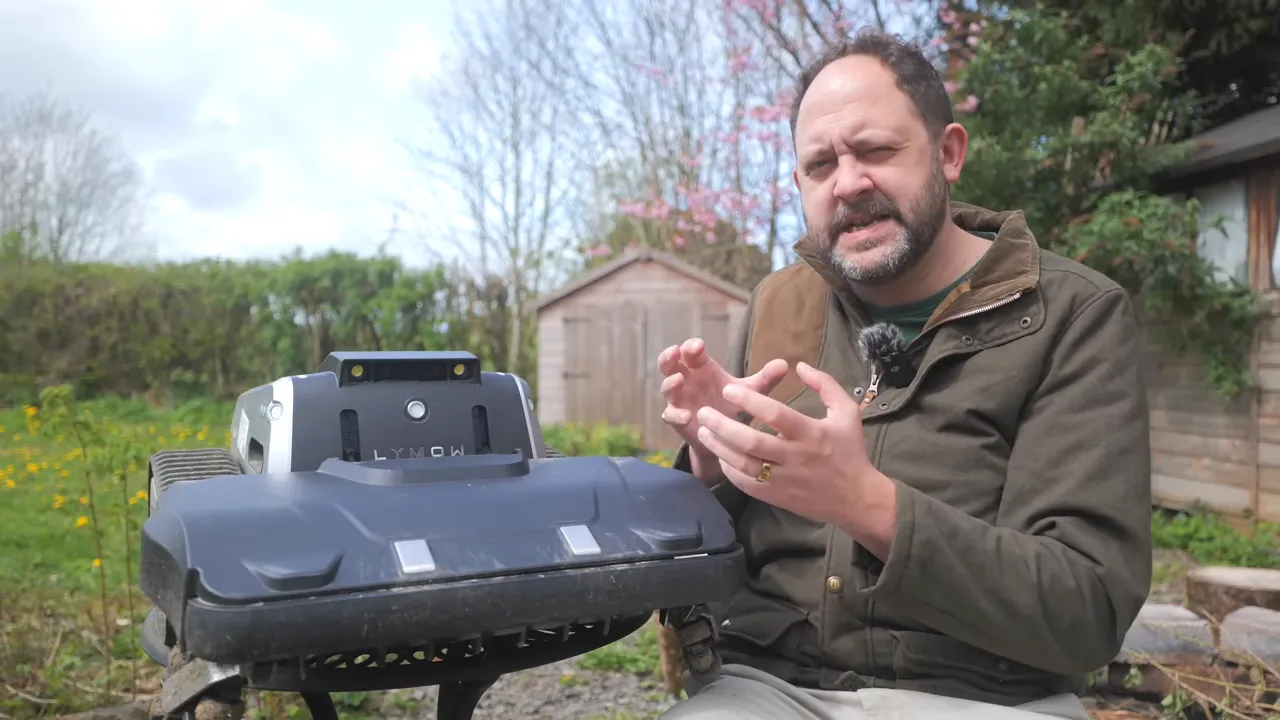
Easier Blade Removal
We discovered another improvement after a piece of rope became tangled around one of the blades. Not ideal, obviously, but useful for finding out how awkward maintenance is going to be.
The new blade assembly comes off with a single bolt. The older design used a nyloc nut, whereas this arrangement proved simple and quick to remove when we needed to clear the tangle.
It is a small detail, but easier access matters on equipment that spends its life collecting grass, dirt and the occasional thing you really should have picked up beforehand. Any blade maintenance should, of course, be carried out with the mower safely shut down.
The Side-Ejection Cover Still Needs Work
The inside of the deck has been reconfigured, and the side ejector has changed slightly too. This is one area where I think Lymow still has room to improve.
The removable cover is made from a soft, silicone-like rubber material. It does not completely prevent material escaping sideways when fitted. Larger twigs and bits of branch can also lodge around it, allowing grass and mulch to accumulate behind them.
In my testing, that buildup did not affect mowing performance. It is more of a design irritation than a fundamental flaw, but I would like to see it addressed. A solid cover might be a better solution for a future version.
The Best Change Might Be the Charging Contacts
More cutting power is lovely. Better obstacle recognition is welcome. But the change I am most pleased to see is rather less glamorous: Lymow has moved the charging contacts.
On the original One, the contacts were underneath the mower. That put them in an excellent position to collect grass, mud and assorted garden gunk, particularly when mowing longer growth or wet grass.
If enough muck covered them, the robot could return to its dock and then fail to charge. The app would notify you, but a notification does not put your wellies on for you.
You still had to traipse out, turn over a very heavy mower and clean the contacts. Neither the One nor the One Plus is something you casually flip around with one hand.
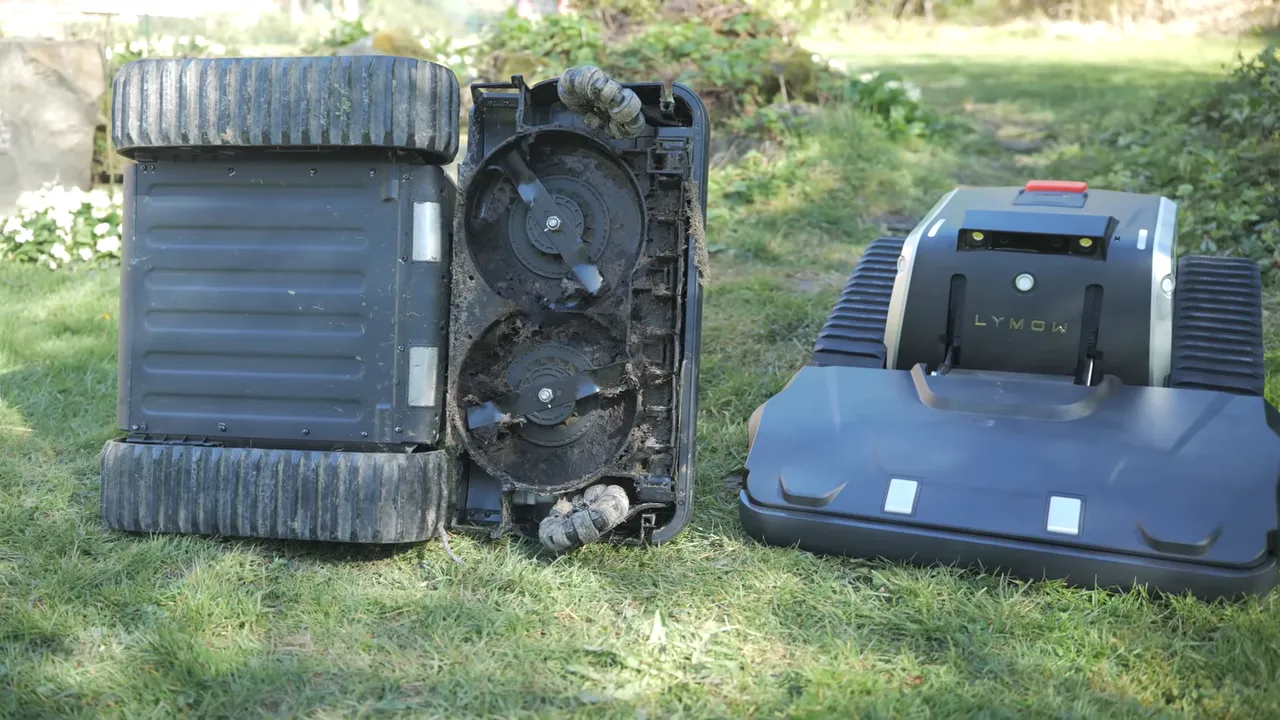
The One Plus puts its two charging pads on top of the cutting deck, where they are much less exposed to that mess.
Better still, the dock has brushes that clean the contacts as the mower enters. It is a wonderfully straightforward bit of engineering, and one of the few docking arrangements I have encountered that actively cleans its charging contacts on arrival.
Bravo, Lymow. That is properly useful.
If you already own the original One, the practical advice is to avoid wet mowing and keep up with the grass rather than waiting until the garden resembles Jumanji. That helps reduce the conditions that make dirty contacts a nuisance in the first place.
The RTK Station Is Still My Main Grumble
There is one thing I had hoped would disappear with the Plus: its reliance on a separate RTK reference station.
RTK, or real-time kinematic positioning, is the positioning technology involved here. My objection is not that precise navigation is bad. It is that the physical station means more equipment, more cabling and another thing to install.
I would rather avoid planting another technological wizard’s staff in the garden if I can help it.
For straightforward setup, I prefer systems using network RTK or visual navigation without a local reference station. As a rough comparison from my experience, setting up a system like the Lymow can take around 20 to 30 minutes, compared with less than five minutes for a network RTK system.
I do appreciate the precision argument, particularly for carefully defined shapes and complicated multi-zone gardens. That is a worthwhile trade-off for some properties, including the sort of terrain I have here. It does not stop me wishing Lymow would offer a version without the separate station.
What Else Would I Like?
Beyond the side-ejection cover and RTK setup, my wish list is getting fairly indulgent:
- A rear collection sweeper to add another useful garden-cleaning function.
- A little lens wiper so it can clean its own face when the cameras get mucky.
- A garden patrol mode that visits selected locations, takes photographs and sends them to the app.
Those are ideas for future products, not features of the One Plus. The fact that I am reaching for extras like these says quite a lot about how refined the core machine already feels.
Should Lymow One Owners Upgrade?
Probably not.
That might sound odd after spending so much time explaining why the Plus is better, but “better” and “you need to replace yours” are not the same thing.
The original Lymow One remains an excellent machine. It earned my praise last year, and the arrival of a revised model does not suddenly make those strengths disappear. Lymow has also continued improving the original’s software experience.
Technology companies love an iterative update. Some manage to sell us what feels suspiciously like the same phone year after year and convince us it is a revelation. At least here, there are tangible hardware improvements aimed at real ownership annoyances.
If your original One is working well, you should not feel short-changed because a Plus has arrived roughly a year later. You still have a cracking piece of kit.
You might want the extra clearance, stronger cutting system, quicker object handling or revised charging arrangement. Whether those justify replacing your mower depends on how much the corresponding issues affect your garden.
Verdict: Familiar, but Properly Refined
The Lymow One Plus is a clear example of a manufacturer listening to feedback and making thoughtful changes rather than redesigning something simply to make it look new.
Its strengths are particularly compelling for uneven gardens, steep sections, rough access routes and multiple separate lawns. The tracks remain excellent, the additional clearance reduces grounding, the cutting system has more power behind it, and the new charging arrangement addresses one of the original’s most practical frustrations.
It is not flawless. I still dislike the extra RTK equipment, and the side-ejection cover deserves another rethink. For the right garden, though, it is quite frankly superb.
It is only April in my 2026 testing, so I am not handing out a favourite-of-the-year crown just yet. But this will certainly be up near the top of my shortlist.
For existing owners, the original is still great. For new buyers, the One Plus is the same excellent idea, made better.


