Nearly 3,000 Amazon reviews and a 4.5 out of 5 rating. That is quite a reputation for a pair of speakers costing £119 at the time of my review. Surely the Edifier R1280DB must be something special?
Well, they certainly had their moments. My first proper music test had me wondering why I had never tried them before. A week of using them with my TV, however, brought things back down to earth.
I also bought them for a slightly unusual purpose: to dismantle them and build the components into a TV cabinet. Before committing that particular act of speaker heresy, I wanted to find out whether the sound was worth keeping.
Quick Summary
- Music became much more enjoyable after modest tone adjustments and an increase in volume.
- Optical TV connections require PCM output because the R1280DB does not support Dolby Digital.
- TV dialogue sounded muddy and less prominent than through other speakers I have tested.
- Excellent connectivity did not outweigh my concerns about clarity and value at roughly £120.
First Impressions: A Few Rough Edges
The R1280DB was available in wood-effect and black finishes when I bought it. I chose the wood version, partly because there was still a chance I might like the speakers enough to leave them intact.
Out of the box, they felt reasonably substantial. Not enormously heavy, but chunky enough to make a decent first impression. The built-in power supply was another welcome discovery, although slightly less convenient for someone planning to take everything apart.
The finish was less impressive. My pair had what appeared to be glue showing around some edges, along with a small loose-looking piece of trim near the side controls. They looked better in the product pictures, frankly.
The box had taken a knock in transit, which initially concerned me, but these finishing details were what actually caught my attention during unpacking. They might not matter much to a cabinet-building lunatic with a dismantling plan, but they would annoy me if I intended to keep the speakers as supplied. Budget pricing does not mean the finishing should be beyond criticism.
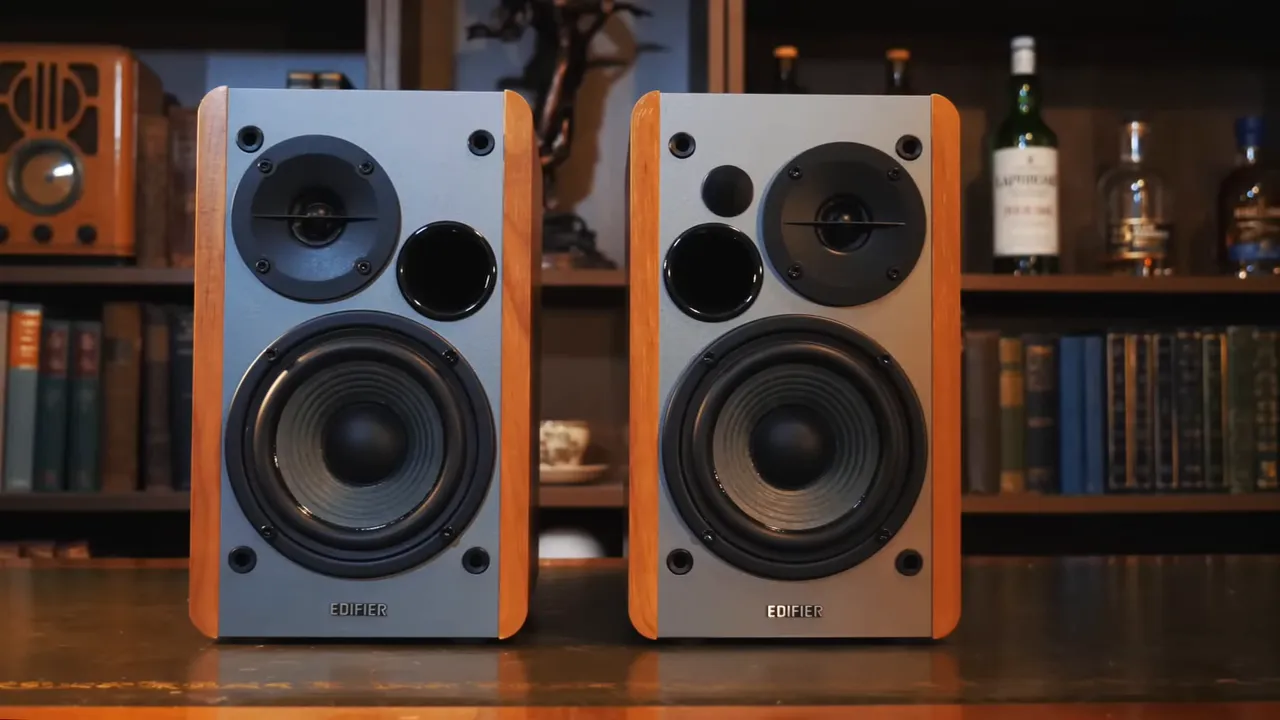
Removing the grilles improved matters enormously. The exposed drivers give them a rather pleasing retro look. Much more my sort of thing.
Connections Are Their Biggest Strength
Behind those removable grilles, the R1280DB has a 4-inch bass driver, a 13mm tweeter and a front-facing bass port. There is also an infrared receiver for the supplied remote.
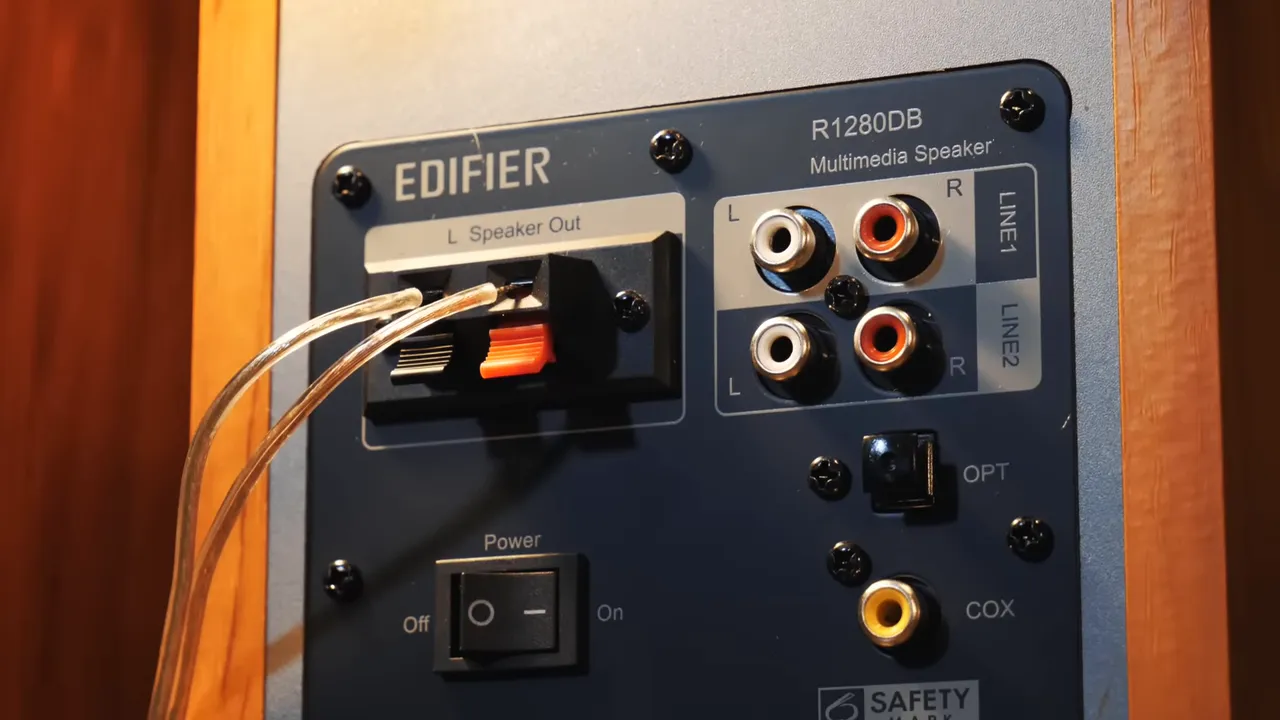
Useful hardware, certainly. But the real highlight is the range of connection options:
- Optical input for a compatible digital audio source, such as a TV.
- Coaxial digital input for another digital connection option.
- Two RCA inputs for analogue sources.
- Bluetooth for wireless audio.
That is a helpful selection, and it makes these speakers genuinely versatile. Whatever reservations I have about the sound, Edifier has done an extremely good job of providing ways to get audio into them.
On the side, you get onboard controls including bass and treble adjustment. Alternatively, there is a remote, which is considerably smaller than I expected. Convenient, yes, but also exactly the sort of thing I am going to lose down the back of a chair.
Music Test: Underwhelming at First, Then Quite a Surprise
I began with the bass and treble controls at zero and the volume fairly low. The result was perfectly acceptable, but hardly the revelation that thousands of positive reviews had led me to expect.
They sounded all right. That was about it.
I then changed to a more engaging track and nudged both the bass and treble upwards. A couple of people had recommended doing this, and the difference was immediately noticeable.
The bass had real strength, and the whole presentation became much more enjoyable. Turning the volume up further was where the speakers really began to impress me. By the time I pushed them to full volume, they were kicking out a considerable amount of sound.
That initial shrug became genuine surprise. There was a very nice sound here, particularly at higher levels, and I could suddenly understand why so many people recommend them.
There is an important distinction, though: enjoying a lively music demonstration is not the same as deciding a speaker is a brilliant all-round purchase. My early enthusiasm was real, but I still needed to use them for the job I had actually bought them to do.
Using the Edifier R1280DB With a TV
Over the following week, I used the speakers in several ways, primarily connected to my television. If their internals were going to end up inside a TV cabinet, the TV experience needed to be right.
Two things stood out: an audio-format limitation and dialogue that was not as clear as I wanted.
Optical Audio Requires PCM, Not Dolby Digital
The R1280DB does not support Dolby Digital. If your television sends Dolby Digital audio through its optical output, these speakers will not play it.
I had not considered that when buying them. The solution was to change the TV’s digital audio output to PCM.
For anyone unfamiliar with the term, PCM stands for pulse-code modulation. The practical point here is simple: when connecting these speakers over optical, check the television’s audio-output setting rather than assuming the connection will work with its existing format.
Dialogue Was the Weak Point
Once connected correctly, the speakers did a good job with bass, music and soundtracks. Their ability to deliver an enjoyable sound at higher volume was still very much there.
Vocals were another matter. During TV use, I found voices a little muddy. Dialogue did not feel as prominent as it had through other speakers I have tested.
That matters. A soundtrack can have plenty of impact, but if speech does not come through with the clarity I want, the overall TV experience suffers.
I am not saying these are bad TV speakers. They are good in several respects. At roughly £120, though, they did not blow me away, and they certainly are not the best speakers I have used with a television.
Yes, I Dismantled Them Anyway
Despite those reservations, the speakers still ended up being taken apart and incorporated into my homemade TV cabinet.
One of my biggest irritations with technology is allowing it to dictate how a room looks. I wanted to do the opposite: make the technology fit my home, with a bit of old-world, rustic character rather than another set of boxes defining the space.
That meant using the Edifier components in a piece of furniture whose appearance I could control.
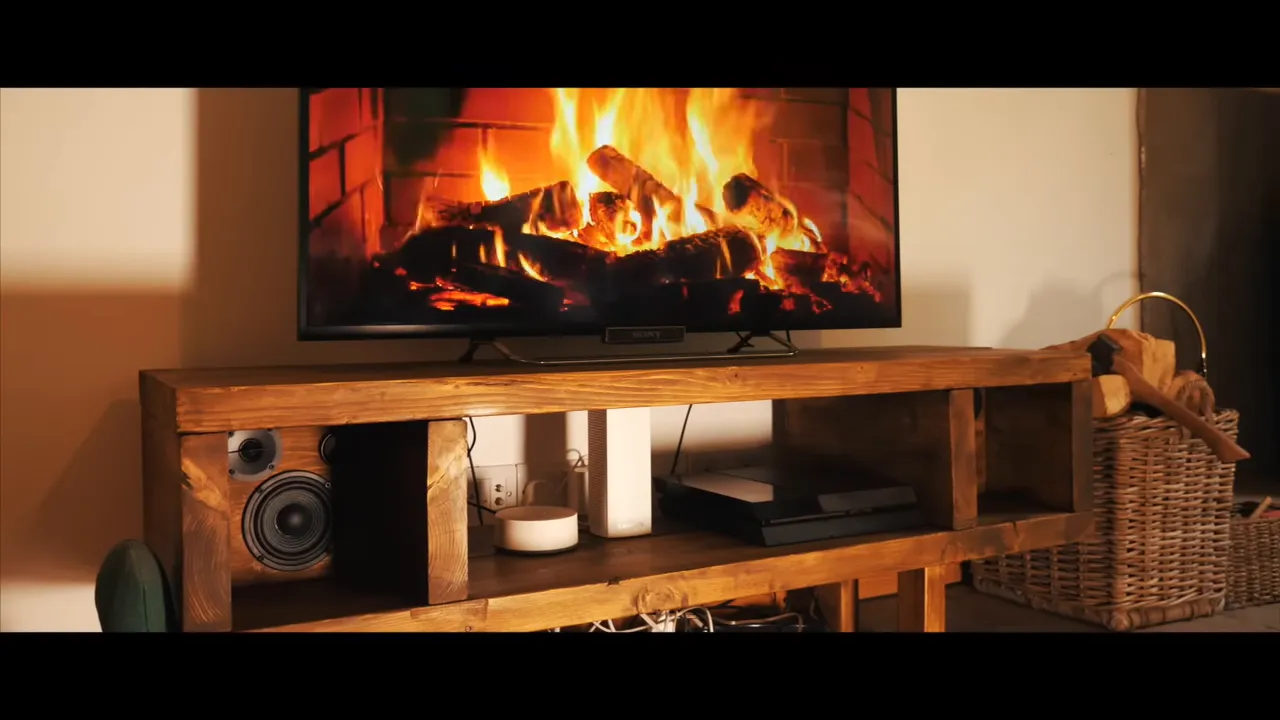
Of course, changing the enclosure may change the sound the manufacturer intended. I fully accept that. This was a personal furniture project, not an attempt to prove I could improve Edifier’s acoustic design.
My house, my speakers, my style. I am happy with the result.
I do not regret choosing these for the build, either. They were not massively expensive, and if something had gone wrong, it would have been rather less painful than dismantling a £200 or £300 pair.
To be absolutely clear, though, my verdict on the R1280DB concerns the standard speakers, not the modified cabinet. Those are two different things.
Final Verdict: Good Speakers, but Not the Bargain the Hype Suggests
The Edifier R1280DB speakers are good. They can be thoroughly enjoyable with music, their bass has plenty of presence, and they produce an impressive amount of sound when turned up. The connection options are excellent.
What I cannot quite get behind is the idea that they are amazing for the money.
- What impressed me: strong bass, enjoyable music playback at higher volumes, and a versatile selection of inputs.
- What disappointed me: untidy finishing on my pair, less convincing initial playback at low volume with neutral tone settings, and muddy TV dialogue.
- The setup limitation: optical TV audio needs PCM because Dolby Digital is unsupported.
- The value question: at the £119 to £120 price I paid, I wanted better clarity.
Would I rush out and buy them again? Unlikely.
I suspect there are better options at around this price, or with a little more budget, although that is not a claim that any particular alternative won a direct comparison here. My issue is simply that the clarity did not justify the level of enthusiasm surrounding them.
If connectivity is your priority, there is a lot to appreciate. If clear dialogue and overall audio quality for the price matter most, I would not let the sheer number of positive reviews make the decision for you.
Overrated? To my ears, yes. Bad speakers? No. There is quite a difference.


